When Is the Best Time to Paint a House Exterior on Cape Cod?
Late May through September is the dependable window, and the shoulder weeks can work with the right product. Here is the data behind that answer, and the daily checks that matter more than the month.
 By Vinny, Mainsail Painting
In this article 11 sections
- The short answer: late May through September
- What the paint can says: temperature limits by product
- Why the Cape's weather plays by its own rules
- Dew, fog and the end of the painting day
- Sun and heat: follow the shade
- Rain and wet wood
- Spring or fall: which is better on Cape Cod?
- Older homes: the lead-safe rule comes first
- Booking an exterior job: what to settle before the season
- Frequently asked questions
- Sources
The short answer
Late May through September is the dependable window. At Hyannis, average lows stay at 48°F or warmer from May through September.[1]
Many acrylic house paints are rated down to 35°F,[4][6] but stains often need 40–50°F.[7][8] The label of the product going on your house is the rule that counts.
The day matters more than the month: dry wood, a surface at least 5° above the dew point,[4] no hot direct sun, and enough drying time before the evening dew.[9]
In the fall, the median first 36°F night at Hyannis comes around October 14 and the first freeze around October 28.[2] Plan exterior work to finish before then.
House built before 1978? In Massachusetts, disturbing more than 20 square feet of painted exterior must be done by a lead-safe renovation (LSR) contractor with a state license.[17]
The short answer is summer. The useful answer is a little longer, because what decides whether exterior paint lasts is not the month on the calendar but the conditions on the day it goes on, and the night after. This guide puts the numbers in one place: what paint and stain manufacturers require, what NOAA’s climate records say about Cape Cod’s seasons, and why dew and fog shape the painting day here.
The short answer: late May through September
Exterior paint needs warm air, a warm and dry surface, and a night that doesn’t undo the day’s work. On Cape Cod those conditions line up most reliably from late May through September. The table below uses NOAA’s U.S. Climate Normals for Hyannis (Barnstable Municipal Airport), the official 30-year averages for 1991–2020.[1][2] The last column is our reading of those numbers against the product limits in the next section.
| Month | Avg. high | Avg. low | Our reading |
|---|---|---|---|
| April | 55°F | 39°F | Early. The median last freeze is around April 22, and nights stay cold. |
| May | 65°F | 48°F | The window opens. The median last 36°F night is around May 3. |
| June | 74°F | 58°F | Good. |
| July | 81°F | 65°F | Good. Plan around the midday sun. |
| August | 80°F | 63°F | Good. Plan around the midday sun. |
| September | 73°F | 56°F | Good. Shorter days and heavier dew late in the afternoon. |
| October | 63°F | 46°F | Closing. The first 36°F night is around October 14, the first freeze around October 28. |
| November | 54°F | 37°F | Usually too cold for a full exterior job. |
From December through March, average lows at the same station sit between 24°F and 30°F,[1] which rules out exterior paint for most products.
Two cautions about any table like this. It describes one station: a yard in Provincetown, Falmouth or Plymouth will run a little different. And it describes averages: a raw week in May or a warm one in October happens most years. The calendar tells you when to book. The forecast for the specific days decides when the brush goes on the wall.
What the paint can says: temperature limits by product
Every exterior paint and stain has an application range printed on its label and in its technical data sheet. House paints and stains don’t share the same limits, even from the same brand. A few examples from widely sold product lines, used here because their data sheets are public:
| Product | Type | Air and surface temperature |
|---|---|---|
| Sherwin-Williams SuperPaint Exterior | Acrylic paint | 35°F and up, and not when it may drop below 35°F within 48 hours[4] |
| Sherwin-Williams Duration Exterior | Acrylic paint | Down to 35°F[5] |
| Benjamin Moore Aura Exterior | Acrylic paint | 35°F to 100°F (surface)[6] |
| Benjamin Moore Arborcoat Semi-Transparent | Waterborne stain | 40°F to 90°F[7] |
| Cabot Semi-Solid Acrylic Siding Stain | Acrylic stain | 50°F to 90°F[8] |
The U.S. Forest Products Laboratory’s general guidance for latex paint is more conservative: apply it at 50°F or warmer, with the temperature expected to stay there for 24 hours, while checking the manufacturer’s requirements, “because some paints can be applied at lower temperatures than these.”[12]
Two things follow. First, “It’s 42 degrees, can we paint?” has no single answer: it depends on the exact product. Second, the limit covers the hours after the paint goes on, not only the moment of application. Cool weather stretches every step: on the SuperPaint data sheet, the recoat time goes from 4 hours above 45°F to 24–48 hours between 35°F and 45°F,[4] and Benjamin Moore notes that “high humidity and cool temperatures will result in longer dry, recoat and service times.”[6]
Why the Cape’s weather plays by its own rules
Woods Hole Oceanographic Institution describes Cape Cod’s climate as “made more moderate by the surrounding ocean which prevents extremes of heat and cold.”[3] For exterior paint that cuts both ways.
The heat is moderate: Hyannis averages about 81°F on a July afternoon.[1] The early fall is mild: on the averages, September (73°F by day, 56°F at night) is warmer than May (65°F and 48°F).[1] But moisture is a regular visitor. WHOI notes that “there are usually three to five days of fog each summer month along the shore.”[3] Fog and dew put water on the surface, and water on a fresh coat is the most common way a well-timed paint job still goes wrong.
Dew, fog and the end of the painting day
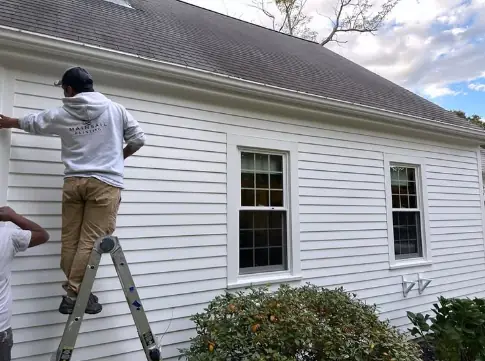
The rule of thumb printed on Sherwin-Williams data sheets is simple: “check to be sure the air, surface, and material temperature are above 35°F (1.7°C) and at least 5° above the dew point.”[4] The same company’s homeowner guidance adds that the temperature should ideally stay in the product’s range “and above the dew point for at least 48 hours after application,” and that “most products require at least 4 hours of dry time before moisture can settle on the surface.”[9]
The dew point matters at both ends of the day. In the morning, siding that faced a clear night is often wet, and paint should wait until it has dried. At the other end, dew comes back fast: “dew will form on almost everything as soon as the sun sets, and seep into the uncured paint.”[10] The Forest Products Laboratory gives the same advice in plainer words: avoid painting late in the afternoon if heavy dew is expected during the night.[12]
What happens when dew, fog or a light shower reaches fresh latex paint? Usually a cosmetic problem called surfactant leaching: tan, brown or glossy streaks that show up when latex paint is “applied in cool, damp and humid conditions or the freshly painted surface is exposed to dew or light rain.” According to Dunn-Edwards’ technical bulletin, the streaks “pose no threat to the durability or integrity of the paint film” and can usually be rinsed off with a garden hose.[11] The same bulletin’s prevention advice reads like a description of a Cape Cod shoulder season: don’t paint late in the day when mist or dew may be present, and don’t paint the day before or after forecast rain.[11]
That is why it makes sense to start a little later and stop earlier in September and October than in July: the dry part of the day is shorter at both ends.
Sun and heat: follow the shade
Cape Cod summers are mild, but a wall in full sun can get much hotter than the air around it. Sherwin-Williams’ advice is direct: “It’s best to avoid painting in direct sunlight, especially during the hot summer months,” and for stains, “never stain in direct sunlight.”[9] Benjamin Moore’s Arborcoat data sheet explains why: direct sun “will prevent the product from penetrating properly, causing lap marks.”[7] Aura Exterior lists a maximum surface temperature of 100°F.[6]
The Forest Products Laboratory adds a subtler point: avoid painting a hot surface in direct sunlight, and also “a cool surface that the sun will heat within a few hours.”[12] The usual answer is to work around the house with the shade, painting each side after the sun has left it, or before it arrives once the morning dew has dried.
Rain and wet wood
Rain right after painting is the obvious risk, and modern paints have narrowed it: the SuperPaint data sheet lists “improved early moisture resistance (1-2 hours).”[4] The less obvious risk is painting wood that is still wet from yesterday’s rain. Sherwin-Williams suggests waiting “a MINIMUM of one day after a heavy rain,” and reminds that “the surface must be dry before painting.”[9]
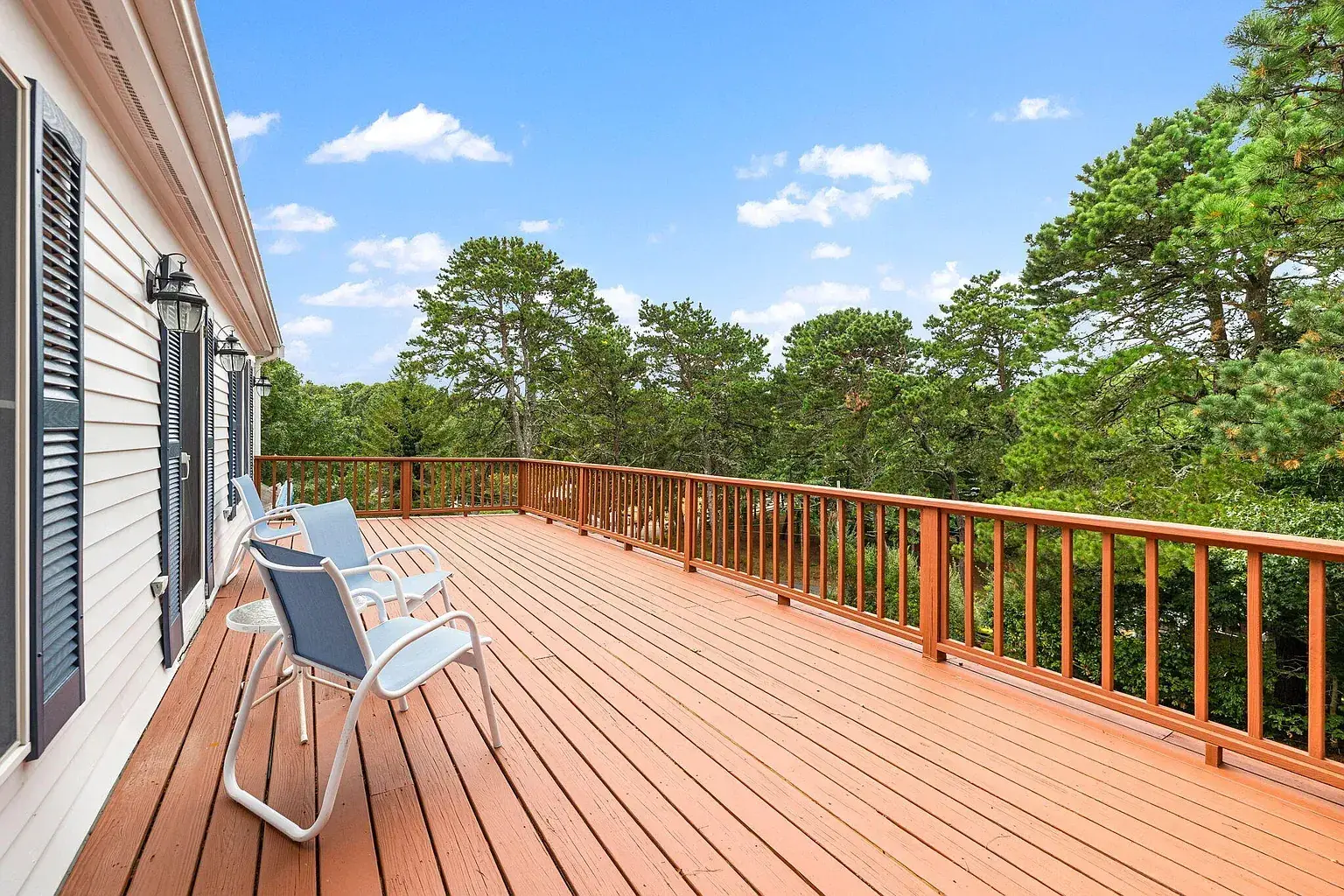
Dry means measurably dry. The Forest Products Laboratory found that “if the MC [moisture content] of wood exceeds 20% when the wood is painted, the risk of blistering and peeling is increased.”[12] Its guide to shake and shingle siding gives the same 20% limit for finishes on cedar shingles, and asks for temperatures “above 40° to 50°F (depending on the manufacturer)” during application and for 24 hours after.[13] For new pressure-treated lumber on a deck, Benjamin Moore asks for a moisture content below 15% before its stain goes on.[7] If your project includes a deck or natural wood, see our pages on deck refinishing and wood staining.
Spring or fall: which is better on Cape Cod?
Both shoulder seasons can work, with different risks.
- Late spring (May). The days are long, but nights stay cold into May: the median last 36°F night at Hyannis is around May 3.[2] April and May also bring about 3.9 and 3.4 inches of precipitation on average, against 2.7 inches in July,[1] so wood may need dry days before it is ready.
- Early fall (September into early October). On the averages, September is warmer than May by day and by night.[1] The trade-offs are shorter days, heavier dew and the clock running toward the first cold nights. Sherwin-Williams flags a classic fall mistake: painting “when daytime temperatures rise above 50° F and nighttime temperatures drop below 35° F,” and adds that “the cooler the temperature the sooner you should stop painting.”[9]
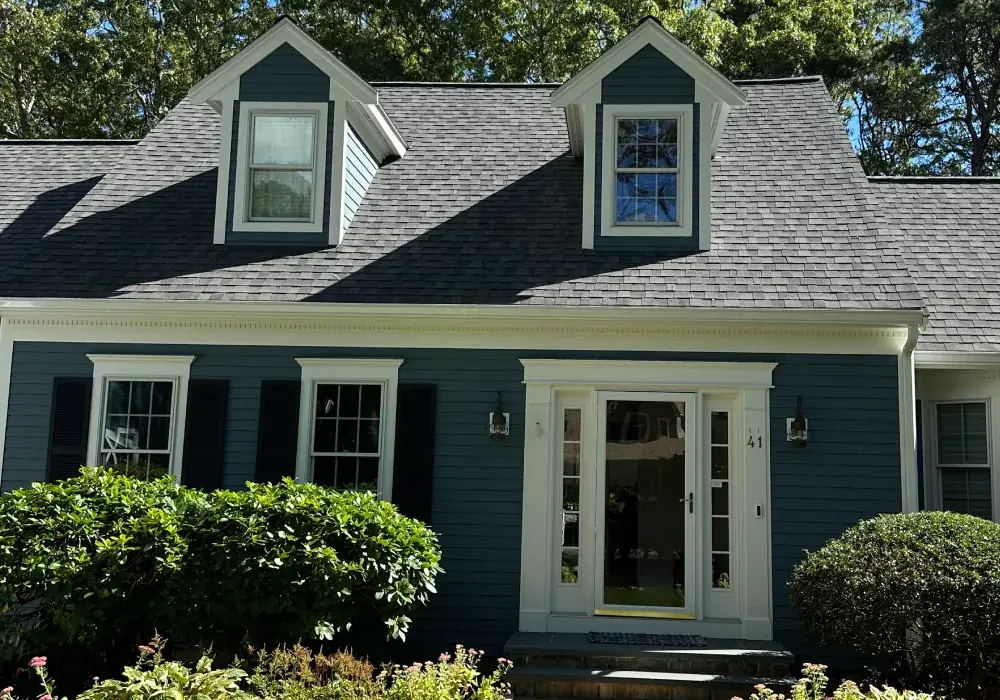
For a full exterior repaint, the safest booking is the core of the season, June through early September. For smaller jobs, such as trim, doors or one elevation, the shoulder weeks are often fine with a low-temperature product and a careful eye on the forecast. You can see finished Cape Cod exteriors in our inspiration gallery.
Older homes: the lead-safe rule comes first
If your house was built before 1978, the timing question has a legal step in front of it. The EPA’s Renovation, Repair and Painting (RRP) Rule covers work in “houses, apartments and child-occupied facilities … built before 1978.”[14] Work that disturbs 20 square feet or less of painted exterior surface counts as minor repair, as long as none of the prohibited practices is used; above that, the rule “requires renovation firms to be EPA-certified.”[15] The prohibited practices include open-flame burning or torching of painted surfaces, high-speed sanding or grinding without a shroud and a HEPA vacuum attachment, and heat guns above 1,100°F.[15]
Massachusetts runs its own program: the EPA authorized the state to administer it in 2010.[16] Under the state rules, painting work for a fee on a pre-1978 home that disturbs more than 20 square feet of exterior painted surface “must be carried out by lead-safe renovation (LSR) contractor,” and “a LSR supervisor is required to be on site at all times while renovation work is in progress.”[17] The state issues the LSR contractor license under 454 CMR 22.00.[18] Ask any painter you hire for an older house for their Massachusetts LSR license before you book.
Booking an exterior job: what to settle before the season
The dependable window is about four months long, and it’s the same four months for every exterior project on the Cape. A few things are worth settling before the first warm week:
- The walkthrough and the quote. At Mainsail Painting we visit within 24 hours and send a written quote within one business day, so you have time to compare and plan.
- The products. Ask which paint and stain will go on, and read their data sheets: the temperature range, dry times and recoat times are all there.
- The weather plan. Ask what happens when the forecast turns: rain, a cold night, a foggy morning. A good answer moves the crew to another side of the house or another day.
- The prep. Every surface should be prepped and primed before it is painted. On our jobs the site is picked up at the end of each day, and when the work is done you walk the house with your project manager.
Vinny, Project Manager Alan, Bernard and the amazing team at Mainsail Painting just completed an exterior paint project at my home! I could not be more pleased with the results!
If you are planning for next season, see how we approach exterior painting on Cape Cod, or send the request below with your ZIP code.
Frequently asked questions
Can you paint a house exterior in October on Cape Cod?
How cold is too cold to paint outside?
How long after rain can you paint the outside of a house?
Can you paint in direct sunlight?
What happens if dew or fog hits fresh paint?
Latex paint can show tan or brown streaks called surfactant leaching. They don’t affect the paint’s durability and can usually be rinsed off with a garden hose.[11]
Sources
Every fact about paint, weather or regulation in this article links to one of these pages. Sources checked on .
- NOAA National Centers for Environmental Information. U.S. Climate Normals 1991–2020: monthly normals, Hyannis Barnstable Municipal Airport, MA (USW00094720). Data file. ncei.noaa.gov ↩
- NOAA National Centers for Environmental Information. U.S. Climate Normals 1991–2020: annual and seasonal normals (freeze dates), Hyannis (USW00094720). Data file; 50% probability dates. ncei.noaa.gov ↩
- Woods Hole Oceanographic Institution. Geography & Climate. whoi.edu ↩
- Sherwin-Williams. SuperPaint Exterior Latex Low Lustre, product data sheet. sherwin-williams.com ↩
- Sherwin-Williams. Duration Exterior Acrylic Latex. sherwin-williams.com ↩
- Benjamin Moore. Aura Waterborne Exterior Soft Gloss (N632), technical data sheet (PDF). media.benjaminmoore.com ↩
- Benjamin Moore. Arborcoat Waterborne Exterior Stain, Semi-Transparent (N638), technical data sheet (PDF). media.benjaminmoore.com ↩
- Cabot. Semi-Solid Acrylic Siding Stain. cabotstain.com ↩
- Sherwin-Williams. Exterior: Product Application Frequently Asked Questions. sherwin-williams.com ↩
- Sherwin-Williams. Late-Season Exterior Painting. sherwin-williams.com ↩
- Dunn-Edwards. Technical Bulletin: Surfactant Leaching (PDF). dunnedwards.com ↩
- USDA Forest Service, Forest Products Laboratory. Wood Handbook, Chapter 16: Finishing of Wood (FPL-GTR-190) (PDF, archived copy of the laboratory’s original file). web.archive.org ↩
- USDA Forest Service, Forest Products Laboratory. Installation, Care, and Maintenance of Wood Shake and Shingle Siding (FPL-GTR-202) (PDF, hosted by the Cedar Shake & Shingle Bureau). cedarbureau.org ↩
- U.S. Environmental Protection Agency. Renovation, Repair and Painting Program: Contractors. epa.gov ↩
- U.S. Environmental Protection Agency. Small Entity Compliance Guide to Renovate Right (EPA-740-K-26-003) (PDF). epa.gov ↩
- U.S. Environmental Protection Agency. Massachusetts Authorized to Implement Lead Renovation Program (news release, July 22, 2010). epa.gov ↩
- Mass.gov, Department of Labor Standards. Lead-safe renovation for homeowners. mass.gov ↩
- Mass.gov, Department of Labor Standards. Lead-safe renovation for contractors. mass.gov ↩
Share this article